If you are searching for exchange rate Miami services, you may be wondering what documents you need before exchanging foreign currency. For most transactions, a valid government-issued photo ID is an important starting point. However, the documents required can vary depending on the provider, transaction amount, customer profile, and type of transaction.
Travelers, students, business owners, and international visitors may have different documentation needs. Larger transactions may also involve additional identity or transaction verification.
This guide explains the common documents you may need for currency exchange in Miami and how to prepare before visiting a currency exchange provider.
Quick Answer: What Documents Do I Need to Exchange Currency in Miami?

For a typical currency exchange transaction, you should be prepared to provide a valid government-issued photo ID.
Depending on the transaction, a currency exchange provider may also request:
- Passport
- Driver’s license
- State-issued identification
- Permanent resident card
- Other valid government-issued identification
- Proof of address, when required
- Additional information for larger or unusual transactions
- Business documentation for business-related exchanges
Requirements are not necessarily identical at every provider. If you plan to exchange a large amount of money, contact the provider before visiting to confirm what you should bring.
What Is the Exchange Rate in Miami?
The exchange rate in Miami is the rate used to convert one currency into another. For example, a provider may quote a rate for converting U.S. dollars into euros, British pounds, Mexican pesos, or another foreign currency.
The rate offered to customers can change because currency markets move throughout the day. Providers may also apply their own pricing, fees, or margins.
For this reason, do not look only at the headline market rate. Before completing an exchange, ask about the rate you will receive, the amount of foreign currency you will get, and any applicable fees or charges.
Foreign Currency Express provides currency exchange services in Miami and South Florida and offers access to a range of international currencies. Customers can check available currencies and current rates before completing a transaction.
Why Do Currency Exchange Providers Ask for Identification?
Currency exchange businesses operate within financial compliance requirements. Currency dealers and exchangers can be subject to Bank Secrecy Act requirements, including recordkeeping obligations for certain transactions. FinCEN specifically identifies currency exchange as an MSB activity and provides rules concerning records for certain foreign exchange transactions.
The documentation process helps a provider establish who is conducting the transaction and maintain required records. This does not mean every customer will be asked for the same documents. The requirements can depend on the transaction and the provider’s compliance procedures.
What Documents Are Commonly Needed for Currency Exchange?
1. Government-Issued Photo ID
A valid government-issued photo ID is one of the most important documents to have with you.
Depending on the provider, acceptable identification may include:
- Driver’s license
- State identification card
- Passport
- Permanent resident card
- Other valid government-issued identification
Your identification should be valid and readable. If your ID has expired or the information is difficult to verify, contact the provider before visiting.
2. Passport
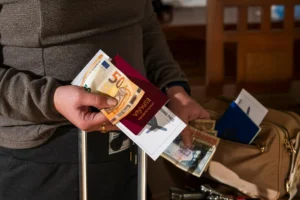
A passport is especially useful for international travelers and non-U.S. residents. If you are visiting Miami from another country, carrying your passport can help establish your identity and travel status. FinCEN rules also specifically address identification and recordkeeping for certain foreign exchange transactions involving non-resident aliens. If you are planning a larger exchange, ask the provider whether your passport or another identification document is required.
3. Proof of Address
Some transactions or provider policies may require additional information about your residential address.
Depending on the provider, examples of supporting documents may include:
- Utility bill
- Bank statement
- Credit card statement
- Lease agreement
- Government correspondence
Do not assume that proof of address is required for every currency exchange. Confirm the requirement before your visit.
Do I Need a Passport to Exchange Currency in Miami?
Not necessarily.
A passport is a commonly used form of identification, particularly for international travelers, but the exact identification requirements depend on the provider and transaction. If you are a U.S. resident with a valid driver’s license or state-issued ID, that may be sufficient for a routine transaction. International visitors should generally carry their passport when visiting a currency exchange provider. The safest approach is to contact the provider in advance if you are unsure which ID is acceptable.
What Documents Are Needed for a Large Currency Exchange?
Larger transactions can involve additional verification. A provider may ask for more information about the customer or transaction, depending on its compliance procedures and applicable regulations. You may be asked for information such as:
- Government-issued identification
- Taxpayer identification information
- Address information
- Details about the transaction
- Supporting documentation related to the source or purpose of funds
Do not assume that a specific document will always be required simply because you are exchanging a large amount. Requirements can vary.
What About Cash Transactions Over $10,000?
Federal reporting rules can apply to businesses that receive more than $10,000 in cash in a single transaction or related transactions. The IRS explains that businesses meeting the applicable requirements must file Form 8300.
This is a reporting requirement for the business, not a rule that simply means customers cannot exchange more than $10,000.
If you are planning a high-value cash transaction, contact the provider before your visit and ask what identification and documentation will be required.
What Documents Do Businesses Need for Currency Exchange?
Business currency exchange can involve different documentation from a personal transaction.
If you are exchanging currency for a company, you may need information such as:
- Government-issued ID for the authorized representative
- Business name and address
- Employer Identification Number (EIN)
- Business registration information
- Corporate or organizational documents, when requested
- Transaction details
The exact requirements depend on the provider and the nature of the transaction.
If your company regularly handles foreign currency, ask the provider about its business account or transaction procedures before making a large exchange.
What Documents Do Students Need for Currency Exchange?
Students traveling abroad may need foreign currency for tuition-related expenses, accommodation, transportation, food, and everyday purchases. For a standard currency exchange, students should be prepared with valid identification. A passport is particularly important for international students and travelers.
Depending on the transaction, the provider may request additional information. Students can also bring supporting travel or education documents, such as:
- Passport
- Student ID
- School or university documentation
- Travel information
These documents may not be required for every transaction, so confirm the requirements before visiting.
What Documents Should Tourists Bring to a Miami Currency Exchange?
International tourists should carry their passport and other valid identification when exchanging money. You may also want to keep your travel documents available, particularly if you are making a larger transaction.
Useful documents can include:
- Passport
- Valid government-issued identification
- Travel information
- Supporting documents requested by the provider
Hotel reservations or flight itineraries are not automatically required for every currency exchange. Avoid assuming that travel documents are mandatory unless the provider specifically requests them.
How Does the Currency Exchange Process Work?
The process is usually straightforward.
Step 1: Check the Currency You Need
Confirm that the provider handles the currency you want to buy or sell. Foreign Currency Express lists multiple international currencies and recommends checking availability for specific currencies or larger transactions.
Step 2: Confirm the Current Rate
Ask for the current customer exchange rate before completing the transaction. Rates can change, so checking the rate on the day of your exchange is more useful than relying on an old online example.
Step 3: Present Your Identification
Provide the requested identification and any additional documentation required for your transaction.
Step 4: Review the Transaction
Before handing over your money or accepting the foreign currency, review:
- Exchange rate
- Currency amount
- Fees or charges
- Final amount you will receive
Step 5: Complete the Exchange
Once you approve the transaction, the provider completes the exchange and provides the applicable transaction record or receipt.
Exchange Rate Miami Beach: Do You Need Different Documents?
Generally, you should not assume that documentation requirements change simply because you are using a currency exchange service in Miami Beach rather than another part of Miami.
The provider and transaction type matter more than the neighborhood. If you are searching for exchange rate Miami Beach or currency exchange services near South Beach, bring valid identification and contact the location in advance if you are planning a large transaction.
Foreign Currency Express operates a Miami Beach location and provides currency exchange services for travelers and other customers.
Exchange Rate South Beach Miami: What Should You Bring?
Customers looking for exchange rate South Beach Miami services should prepare the basic documentation required for a currency exchange. International travelers should consider carrying a valid passport as proof of identity. Meanwhile, U.S. residents may be able to use a government-issued photo ID for routine transactions, depending on the provider’s requirements.
For larger currency exchanges, contact the location in advance to confirm whether additional documentation is necessary.
How to Prepare for a Currency Exchange in Miami
A few simple steps can make the process easier.
Check Identification Before Leaving
Make sure your ID or passport is valid and readable.
Confirm Currency Availability
Not every location will necessarily have every currency available in the amount you need. Call ahead for less common currencies or large orders.
Ask About Documentation
If you are exchanging a significant amount, ask which documents you should bring.
Check the Rate Before You Exchange
Review the current customer rate rather than relying on an old rate shown in an article, search result, or currency calculator.
Ask About the Final Cost
A good comparison should consider the actual amount you receive after any applicable charges, not just the advertised exchange rate.
Keep Your Receipt
Keep the transaction receipt for your records, particularly for business, travel, or accounting purposes.
Common Currency Exchange Documentation Mistakes
Customers can avoid unnecessary delays by checking their documents before visiting.
Common mistakes include:
- Bringing an expired ID
- Forgetting a passport when traveling internationally
- Assuming every provider accepts the same forms of ID
- Failing to ask about requirements for large transactions
- Assuming proof of address is always required
- Waiting until the last minute to request a less common currency
- Comparing rates without checking the final amount received
A short call before your visit can help clarify the provider’s current requirements.
Why Choose Foreign Currency Express for Currency Exchange in Miami?
Foreign Currency Express provides foreign currency exchange services for travelers, businesses, students, and other customers across Miami and South Florida.
The company states that it has served South Florida since 2009 and provides access to more than 70 global currencies. Its services include buying and selling foreign currency, with locations listed across South Florida.
Customers can check available currencies, review current rates, and contact the company before visiting. For larger transactions or less common currencies, confirming availability and documentation requirements in advance can help make the exchange process more convenient.
Final Thoughts
Knowing what documents to bring can make your exchange rate Miami experience simpler and faster. For many routine transactions, start with a valid government-issued photo ID. International visitors should carry a passport, while customers making larger or business-related transactions should contact the provider in advance to confirm whether additional documentation is needed.
Remember that documentation requirements can vary by provider and transaction. Do not rely on a generic checklist alone. Before visiting Foreign Currency Express, confirm the currency you need, check the current exchange rate, ask about documentation requirements, and keep your transaction receipt.
For current currency availability and exchange information, visit Foreign Currency Express or contact the team before your visit.
Frequently Asked Questions About Exchange Rate Miami Services
What ID do I need to exchange currency in Miami?
A valid government-issued photo ID is a common starting point. Depending on the provider and transaction, you may need a driver’s license, state ID, passport, or another acceptable identification document.
Do I need a passport to exchange foreign currency?
Not always. A passport is particularly useful for international visitors, but U.S. residents may be able to use another accepted government-issued ID for a routine transaction.
Do I need proof of address to exchange currency?
Not necessarily. Proof of address may be requested for certain transactions or under a provider’s verification procedures. Confirm the requirement before visiting.
What documents do I need for a large currency exchange?
Larger transactions may require additional identity or transaction information. Contact the provider before visiting to confirm its current requirements.
Can tourists exchange currency in Miami?
Yes. Tourists can use currency exchange services in Miami. International visitors should carry their passport and check the provider’s identification requirements before completing the transaction.